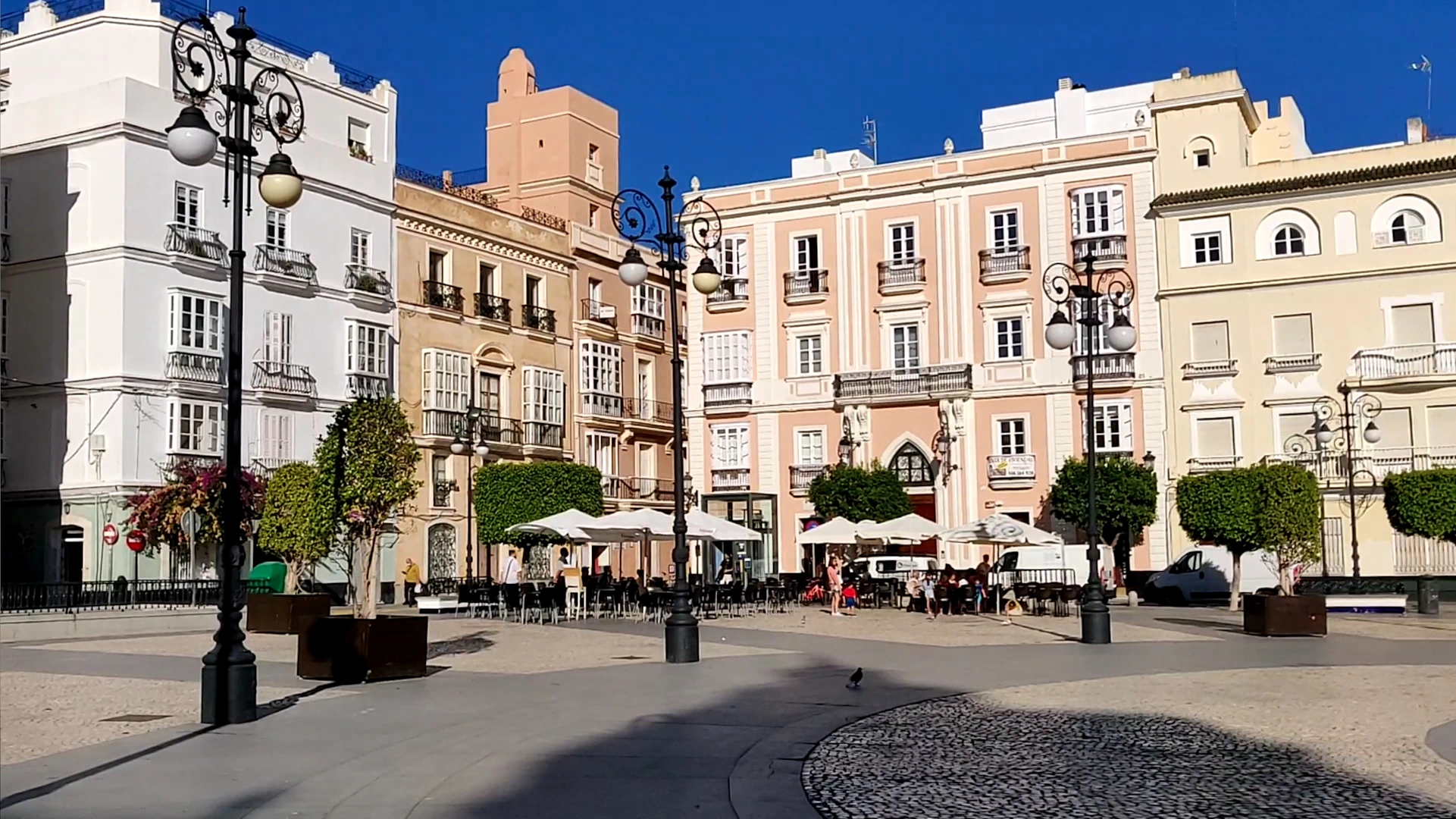
From the Tower to the Theatre: The Essence of Cádiz in One Stroll
A tour that ascends to the Tavira watchtower, immerses itself in the bustle of the market, savors pescaíto frito, admires the Cathedral, and discovers Roman remains, culminating at the iconic Gran Teatro Falla.
Torre Tavira: The Eye of Cádiz
Torre Tavira, named after the city’s first official lookout, Antonio Tavira, is the highest watchtower in historic Cádiz, standing 45 meters above sea level. Built in the 18th century as a viewing tower for a palace house, it now houses a famous camera obscura that projects real-time moving images of the city onto a concave surface.
Climbing its stairs mid-morning already foretold the July heat in Cádiz. The reward, however, was absolute: a 360-degree view over the sea of white rooftops, yellow domes, and the infinite blue of the Atlantic. The camera obscura experience, with the guide pointing out the city’s rooftops like a living map, is unique. From here, Cádiz is understood as the island it is.
Central Market of Abastos: The City’s Pulse
Inaugurated in 1838 under the reign of Isabel II, the Mercado Central is the main food market of Cádiz and one of the oldest still active in Spain. It occupies the site of the former Convent of the Descalzos and its structure, with a central nave and four side aisles, is an example of 19th-century iron and glass architecture. It is the gastronomic heart of Cádiz.
The contrast upon entering was immediate: from the silence of the tower to the bustle and intense smells of the sea. The stalls, packed with gleaming fish, live shellfish, fruits, and vegetables, were a spectacle of color and vitality. The vendors’ cries mixed with the haggling of housewives. I felt the authenticity of a city that lives facing the sea.
Freiduría Las Flores: The Ritual of Pescaíto
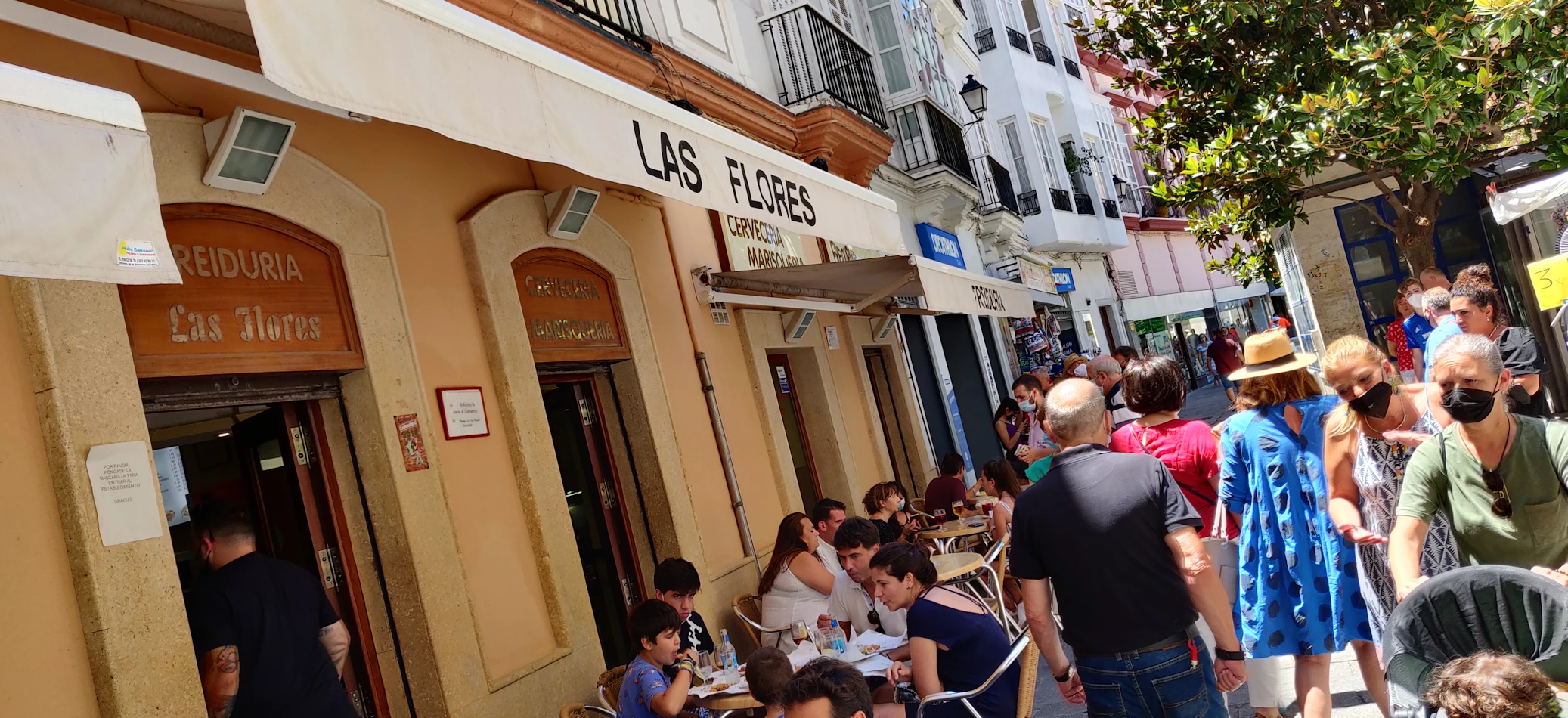
Freiduría Las Flores is an institution in Cádiz, emblematic for its quality and tradition. Located just meters from the market, it represents the essence of quick and tasty Cádiz food: pescaíto frito. This cooking method, which immerses seafood and fish in very hot olive oil, is a culinary legacy dating back centuries.
The smell of frying guided me to the door. The line moved fast. Ordering a portion of “mixed fried fish” and eating it standing in the street, with your fingers, is a mandatory ritual. The crunchy texture on the outside and tender on the inside, the perfect touch of salt… accompanied by a very cold draft beer, was the perfect lunch. Simple, authentic, and delicious.
Cathedral of Cádiz: The Golden House on the Sea
The Cathedral of Cádiz, known as “Santa Cruz sobre el Mar” or “Catedral Nueva,” is a magnificent example of the transition between Baroque and Neoclassicism. Its construction lasted 116 years (1722-1838), which explains the mixture of styles. Its imposing domes covered with yellow tiles, which shine in the sun, and the crypt where composer Manuel de Falla rests stand out.
After lunch, the cathedral rose majestically at the end of the street. The interior is awe-inspiring due to its spaciousness and the light filtering through its stained glass. Climbing the Torre del Reloj for another perspective of the city was worth every step. In the crypt, the feeling of peace contrasted with the exterior bustle. It is a building that summarizes the history and character of Cádiz.
Teatro Romano: Vestiges of Gades
The Teatro Romano de Cádiz, discovered after a fire in 1980, is the oldest Roman theater in the Iberian Peninsula and one of the largest, with an estimated capacity of 10,000 spectators. It dates from the 1st century B.C., from the time of General Lucius Cornelius Balbus, and its construction took advantage of the natural slope of the Cerro de la Popa. It belonged to ancient Gades.
Descending into its interior via the modern walkway is a journey through time. Although partially excavated, its semicircular seating (cavea) and the orchestra space allow one to imagine its original grandeur. The fact that it is integrated into the Pópulo neighborhood, with medieval buildings constructed over its ruins, speaks of the layers of history superimposed in this thousand-year-old city.
Gran Teatro Falla: The Cultural Heart
The Gran Teatro Falla, of Neo-Mudéjar style, began construction in 1884 on the site of the old Gran Teatro de Cádiz, destroyed by fire. Completed in 1905, it owes its name to the illustrious gaditano composer Manuel de Falla. It is the venue for the famous Concurso de Agrupaciones del Carnaval de Cádiz, the most emblematic cultural event in the city.
My walk ended in front of its characteristic red brick façade. Although there was no performance, its mere presence is imposing. I imagined the bustle during Carnival, with the chirigotas singing inside. This theater, proud and stately, represents the joy and creativity of Cádiz. It was a perfect ending for a day exploring the essence of the “Tacita de Plata.”